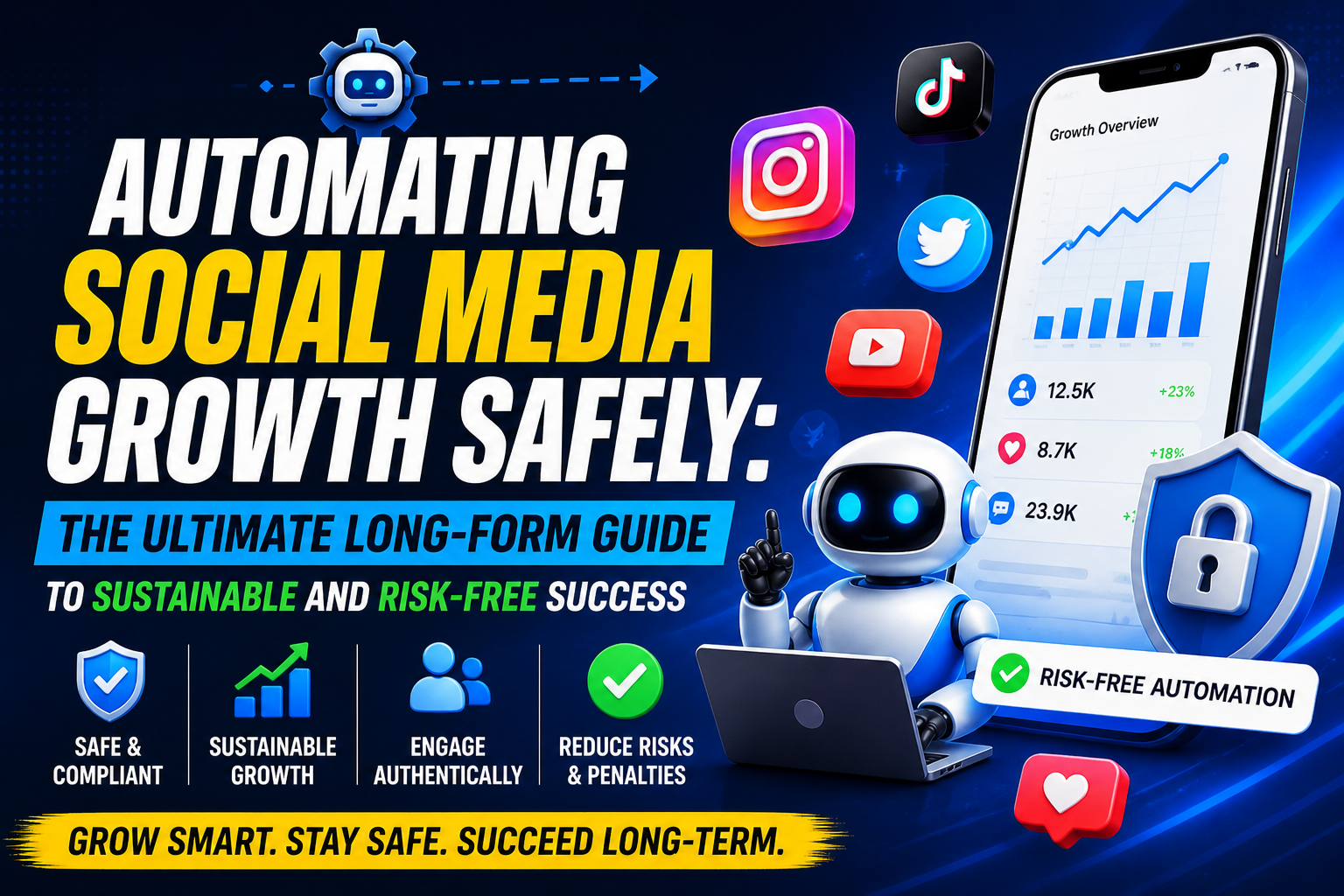
Social media growth has become one of the most powerful drivers of online visibility, brand authority, and digital income in today’s connected world, where billions of users spend hours daily engaging with content across platforms such as Instagram, TikTok, Facebook, LinkedIn, and X; however, while the opportunity is massive, the competition is equally intense, making it increasingly difficult for individuals and businesses to grow their presence organically without a clear strategy, consistent effort, and intelligent use of tools that can reduce manual workload while maintaining quality and authenticity, which is exactly where social media automation enters the picture as a powerful yet often misunderstood approach that can either elevate your growth to new heights or completely destroy your account if used recklessly, making it absolutely essential to understand not only how automation works but also how to implement it safely, ethically, and effectively in a way that aligns with platform policies, builds trust with your audience, and ensures long-term sustainability rather than short-term gains that come with hidden risks.
What Is Social Media Automation? (In-Depth Explanation)
Social media automation can be defined as the strategic use of software tools, artificial intelligence systems, and scheduling platforms to perform repetitive, time-consuming, and predictable tasks on social media accounts without requiring constant manual intervention, and while this may sound simple on the surface, the concept becomes much deeper when examined closely because automation is not just about posting content automatically but also about managing workflows, analyzing user behavior, optimizing timing, organizing campaigns, and ensuring consistency across multiple platforms simultaneously, which would otherwise require hours of daily effort, and when implemented properly, automation acts as a supportive assistant rather than a replacement for human creativity, allowing content creators, marketers, and business owners to focus more on strategy, storytelling, and audience engagement while the system handles the mechanical aspects of publishing and tracking performance.
It is important to understand that safe automation operates within clearly defined boundaries set by social media platforms, meaning it avoids any behavior that mimics spam, manipulates engagement metrics artificially, or violates community guidelines, and instead focuses on enhancing productivity and efficiency in a way that remains transparent and user-focused, ensuring that the account continues to grow organically while benefiting from the consistency that automation provides.
Why Automation Is Essential for Modern Social Media Growth
In the current digital environment, where algorithms prioritize consistency, engagement, and relevance, relying solely on manual effort often leads to irregular posting schedules, missed opportunities, and burnout, which is why automation has become an essential component of any serious social media strategy, as it enables users to maintain a steady flow of content even during busy periods, ensures that posts are published at optimal times when the audience is most active, and provides valuable insights into performance metrics that can guide future decisions, ultimately creating a more structured and data-driven approach to growth that is difficult to achieve manually.
Moreover, automation allows scalability, which is particularly important for businesses and influencers who manage multiple accounts or platforms simultaneously, because as the audience grows, the volume of interactions, messages, and content requirements increases exponentially, making it nearly impossible to handle everything manually without compromising quality or responsiveness, whereas automation tools can streamline these processes and maintain a high level of consistency without increasing workload, thereby creating a sustainable growth model that can adapt to increasing demands over time.
Understanding the Risks of Unsafe Automation in Detail
While automation offers numerous benefits, it also comes with significant risks when used improperly, and these risks are often underestimated by beginners who are attracted by promises of rapid growth, instant followers, and viral engagement, which are typically associated with unsafe automation practices such as bot usage, mass following, automated commenting, and spam messaging, all of which violate platform guidelines and can lead to severe consequences including account suspension, shadowbanning, reduced reach, and permanent loss of credibility, making it crucial to distinguish between safe and unsafe automation methods before implementing any strategy.
One of the most common risks is account restriction, where platforms detect unusual activity patterns such as sudden spikes in likes, follows, or comments that appear unnatural, triggering automated security systems designed to prevent abuse, and once an account is flagged, its visibility can be significantly reduced or completely blocked, which can take weeks or even months to recover from, while in some cases the account may be permanently banned without warning, resulting in loss of all content, followers, and progress built over time.
Another critical issue is the loss of audience trust, as users are becoming increasingly aware of automated behavior and can easily identify generic or repetitive interactions that lack authenticity, which can damage the brand’s reputation and reduce engagement rates over time, highlighting the importance of maintaining a human touch even when automation is used.
Safe vs Unsafe Automation: A Comprehensive Breakdown
Safe automation focuses on enhancing productivity while respecting platform rules and user experience, meaning it includes activities such as scheduling posts, analyzing performance data, organizing content calendars, and managing workflows in a structured manner, all of which are supported by official APIs and approved tools, ensuring compliance with platform policies and minimizing risks.
On the other hand, unsafe automation involves actions that attempt to manipulate algorithms or artificially inflate engagement metrics, such as buying followers, using bots to like or comment on posts, automating direct messages at scale, and engaging in follow-unfollow strategies, all of which are considered violations and can result in penalties, making it clear that the difference between safe and unsafe automation lies not in the tools themselves but in how they are used and the intent behind their usage.
Core Principles of Safe Social Media Automation
To implement automation safely, it is essential to follow a set of core principles that ensure compliance, authenticity, and long-term success, starting with the concept of human-like behavior, which means that automated actions should mimic natural usage patterns rather than creating sudden or excessive activity that appears suspicious, followed by the principle of quality over quantity, where the focus should be on delivering valuable and engaging content rather than increasing the volume of posts without purpose.
Another important principle is gradual scaling, which involves increasing activity levels slowly over time rather than making abrupt changes that could trigger platform detection systems, as well as personalization, where automated messages and responses should be tailored to the audience rather than using generic templates that reduce engagement and authenticity, and finally, strict adherence to platform guidelines, which requires staying updated with the latest rules and policies to ensure that all automation practices remain compliant and risk-free.
Best Tools for Safe Social Media Automation
There are several reliable tools available that support safe automation practices, including Buffer, Hootsuite, Later, and Sprout Social, all of which are designed to work within platform guidelines and provide features such as content scheduling, performance tracking, and audience insights, making them suitable for both beginners and advanced users who want to automate their workflows without compromising safety.
In addition to scheduling tools, analytics platforms like Google Analytics and CRM tools like HubSpot can be integrated into the strategy to provide deeper insights into user behavior, campaign performance, and conversion tracking, enabling more informed decision-making and continuous optimization of content strategies.
Step-by-Step Safe Automation Strategy (Extended Explanation)
The process of automating social media safely begins with defining clear and measurable goals, which could include increasing followers, improving engagement rates, driving website traffic, or building brand awareness, as having well-defined objectives helps in selecting the right tools and strategies that align with desired outcomes rather than using automation blindly without direction.
Once goals are established, the next step is creating high-quality content that provides value to the audience, as automation cannot compensate for poor content quality, making it essential to focus on storytelling, relevance, and audience needs before scheduling posts, followed by building a detailed content calendar that outlines posting frequency, themes, hashtags, and captions, ensuring consistency and organization across all platforms.
After that, scheduling tools can be used to automate the publishing process, while analytics tools track performance metrics such as reach, engagement, and click-through rates, allowing continuous improvement based on data-driven insights, and throughout this process, it is important to maintain a balance between automation and manual interaction by regularly engaging with followers, responding to comments, and participating in conversations to preserve authenticity and build relationships.
Content Strategies That Work Best with Automation
Automation becomes significantly more effective when combined with strong content strategies such as evergreen content creation, which involves producing material that remains relevant over time and can be reused or repurposed across different platforms, as well as batch content creation, where multiple posts are created in a single session and scheduled in advance, reducing daily workload and ensuring consistency.
Repurposing content is another powerful strategy, allowing a single piece of content to be transformed into multiple formats, such as turning a blog post into social media captions, videos into short clips, and podcasts into quote graphics, maximizing reach and efficiency while maintaining content quality.
Common Mistakes to Avoid in Social Media Automation
One of the biggest mistakes in social media automation is over-automation, where too many tasks are automated without considering user experience, resulting in robotic interactions and reduced engagement, followed by neglecting human interaction, which is essential for building trust and maintaining relationships with the audience.
Another common mistake is relying on low-quality or unauthorized tools that promise quick results but often violate platform rules, as well as posting irrelevant or poorly timed content due to lack of planning, all of which can negatively impact growth and credibility over time.
Long-Term Strategy for Sustainable Growth
Sustainable social media growth requires a long-term approach that focuses on building trust, delivering consistent value, and maintaining authenticity, rather than chasing short-term gains through risky automation practices, as true success comes from developing a loyal audience that engages with content genuinely and supports the brand over time.
Automation should be viewed as a support system that enhances efficiency and consistency, while human creativity and interaction remain at the core of the strategy, ensuring that the brand maintains its unique voice and connection with the audience.
Frequently Asked Questions (FAQs)
1. Is social media automation safe?
Yes, social media automation is safe when used responsibly with approved tools and within platform guidelines.
2. Can automation replace human effort completely?
No, automation should support human effort, not replace it entirely.
3. What is the safest type of automation?
Content scheduling and analytics tracking are considered the safest forms.
4. How can I avoid account bans?
Avoid bots, follow platform rules, and maintain natural activity patterns.
5. Are scheduling tools allowed?
Yes, tools like Buffer and Hootsuite are officially supported.
6. Can automation increase engagement?
Yes, indirectly by improving consistency and timing.
7. How often should I automate posts?
Based on your audience behavior, but consistency is key.
8. Is buying followers safe?
No, it is risky and can damage your account.